

Two ways to get a centimetre, and they are not interchangeable
On any given week our crews carry the same Trimble and Leica GNSS heads to very different jobs — a 40 km road corridor in the desert, a cadastral block inside a Giza neighbourhood, a transmission line crossing farmland. The receiver is the same. What changes is where the correction comes from. Either we plant our own base on a known mark and broadcast corrections to the rover (classic base-and-rover RTK), or the rover dials a mountpoint over the internet and pulls corrections from a reference-station network (network RTK over NTRIP, fed by CORS infrastructure).
People treat these as the same thing because both give you RTK on the controller. They are not. The difference shows up the moment you lose cell signal 30 km from anywhere, or the moment a client asks why two crews on adjacent parcels disagree by 4 cm. This guide is how we actually decide, drawn from a fleet of 90 instruments and over a thousand survey projects.
The fleet behind the call
- 90
- Instruments in our fleet
- GNSS, total stations, scanners, drones, levels, sonar
- 1,000+
- Survey projects delivered
- 3000+ km
- Roads surveyed
- Corridors where base-rover earns its keep
- 600+ km
- Railways
- 300+ km
- Power lines
- 2,500+
- Clients served
Base-rover RTK vs Network RTK at a glance
| Criterion | Base-Rover RTK | Network RTK (NTRIP/CORS) |
|---|---|---|
| Correction source | Your own base on a known point | Reference-station network via internet |
| Coverage limit | Radio/range from the base (a few km) | Anywhere with mobile data + network footprint |
| Connectivity needed | None — UHF radio link | Stable cellular / mobile data |
| Setup time on site | Occupy + level base, start broadcast | Connect, authenticate mountpoint, fix |
| Datum control | You own it — base coordinate is yours | Tied to the network's realization |
| Best fit | Remote corridors, no signal, control-critical | Urban/peri-urban infill, mobile crews |
There is no universally 'better' column — the best choice flips with the site.
Coverage is the first filter, not accuracy
On a long road or railway corridor, network RTK looks attractive until the cell bars vanish. We have lost the mountpoint mid-stakeout often enough that on remote alignments we default to base-and-rover: one base on a control mark, UHF radio to the rover, and zero dependence on a SIM card. The trade is range — a base only reaches so far before the baseline grows and the fix degrades, so on a 40 km job we leapfrog the base between control points rather than fight a marginal radio link.
Inside Giza and the Delta towns it inverts. For a cadastral block or a small topographic survey, network RTK over NTRIP lets a single surveyor work all day without a second instrument babysitting a base. One crew, one rover, consistent datum across the whole city because every fix references the same network realization. That consistency is the quiet superpower: two of our crews on neighbouring parcels close to each other because they share corrections, not because they got lucky.
The accuracy reality
Both methods deliver RTK-grade results — typically in the ±15–25 mm horizontal band under good conditions (illustrative range; see the GPS program and NGS RTK guidance below). Base-rover accuracy degrades with baseline length; network RTK accuracy degrades at the edge of the network or under poor satellite geometry. Neither replaces a total station when you need ±2–5 mm on a structure, and neither replaces static GNSS (≈±3–8 mm) for primary control.
How we set up a base-and-rover RTK session
- 1
Recover a known control mark and confirm its published coordinate and datum before anything else — a wrong base coordinate shifts every observed point by the same error.
- 2
Set the tripod and tribrach over the mark, level precisely, and measure the antenna height twice (slant and vertical) to kill the most common blunder.
- 3
Power the base, enter the known coordinate, and start the correction broadcast over UHF radio on a clear channel.
- 4
On the rover, confirm it is receiving the base stream, then initialize until the controller reports a fixed (not float) solution.
- 5
Check into a second known mark as an independent QA shot — if it does not agree within tolerance, stop and re-investigate the base.
- 6
Survey, and at session end re-occupy a check point to prove the fix held; log the antenna heights and base coordinate in the field notes.
Indicative horizontal accuracy by method
Cost and logistics tradeoffs
| Factor | Base-Rover RTK | Network RTK (NTRIP/CORS) |
|---|---|---|
| Hardware on site | Two GNSS heads (base + rover) | One GNSS head (rover only) |
| Recurring cost | None beyond your own kit | Network subscription + mobile data |
| Crew size | Often two for long corridors | Often one |
| Failure mode | Radio range / base disturbed | Lost cell signal / mountpoint down |
| Datum responsibility | You set and verify the base | You inherit the network's frame |
Costs here are directional, not quoted prices — they vary by region, provider, and project scale. · Coordinate-frame and datum considerations per EPSG registry; correction-service behaviour per NGS RTK guidance.
Tie everything back to a defined datum
Per the EPSG geodetic registry and NGS RTK guidance, an RTK position is only as trustworthy as the reference frame behind it. With base-rover you carry that responsibility — the base coordinate and its datum are yours to verify. With network RTK you inherit the network's realization, so confirm the published frame and epoch before you mix that data with older control. We always shoot an independent check mark on both methods; it is the cheapest insurance in surveying.
RTK in the field

The GNSS heads we run
 From our field work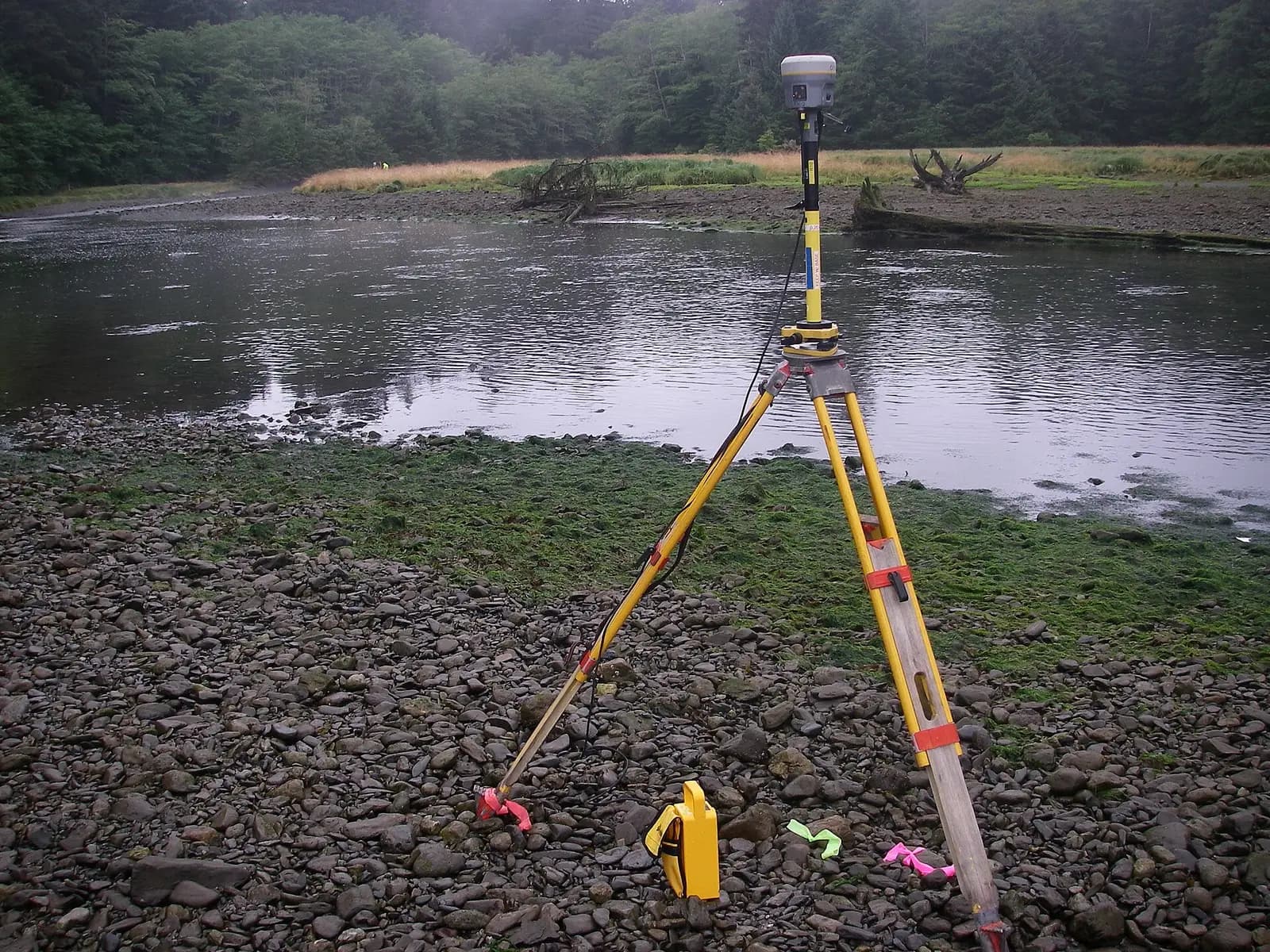
GPS / GNSS / RTK receivers
Survey-grade GPS receivers for centimeter-accurate satellite positioning (RTK) — control, topographic, and cadastral work.
such as Trimble R10/R8, Topcon Hiper V, Leica GS18
Multi-constellation receivers (Trimble, Leica, Topcon) that we operate in both base-rover and network RTK modes.
Keep exploring
References
- GNSS/RTK receiver and survey solution specifications (Trimble) — Trimble
- Guidelines for Real-Time Kinematic (RTK) GNSS surveying and geodetic control — US National Geodetic Survey (NGS/NOAA)
- Global Positioning System (GPS) program — modernization and signal performance — U.S. Government — GPS.gov
- EPSG registry of coordinate reference systems and map projections — EPSG Geodetic Parameter Dataset