

The same gun, a different crew
The question we get from clients pricing a survey is rarely "robotic or manual?" — it is "why does one crew cost what two used to?" The honest answer is the robotic total station. Under the hood it is the same instrument family as the manual one our crews have carried for years — the same angle and distance engine, the same calibration discipline. What changes is who stands where. On a manual instrument, one surveyor stays at the tripod and aims; a second walks the prism. On a robotic instrument, the surveyor walks with the prism, carries the controller, and drives the gun by remote. The instrument turns itself, finds the prism, and locks on. One pair of trained hands now does what two used to do.
That single change ripples through everything: crew cost, daily output, how we lay out a road, even which jobs we say yes to. But it does not make manual instruments obsolete. There are sites where we still reach for the manual gun first — and knowing which is which is the whole craft.
Robotic vs manual, side by side
| Criterion | Robotic | Manual |
|---|---|---|
| Crew size | One person | Two people |
| Who runs the instrument | Rod-holder, by remote | A surveyor at the tripod |
| Prism tracking | Automatic lock & search | Manual aiming each shot |
| Open-site layout speed | Very fast | Moderate |
| Congested / obstructed sites | Lock-loss slows it | Steady, predictable |
| Up-front instrument cost | Higher | Lower |
| Typical line-of-sight accuracy | ±2–5 mm | ±2–5 mm |
| Best for | Stake-out, open topo | Control traverse, monitoring |
Neither wins every row — the highlighted column is the better fit for that criterion. Accuracy ties because the measuring engine is the same class.
Where the robot actually earns its keep
The productivity story is not magic — it is geometry of motion. On a manual layout job, every point is a round trip: the rod-holder calls a position, walks to it, the instrument operator aims and reads, then they talk, adjust, and repeat. With a robot, the surveyor stands at the point with the controller, nudges the position on screen, and the instrument re-shoots in seconds without anyone walking back to the tripod. On open stake-out work — setting out road centrelines, building corners, utility runs — we routinely see one robotic surveyor outpace a two-person manual crew, because the dead time of walking and re-aiming is gone.
The other half of the win is automatic tracking. A robotic instrument locks onto the prism and follows it as the surveyor moves. Lose the lock behind a truck or a wall and a good instrument runs a powered search and re-acquires in seconds. That continuous lock is what makes a one-person crew feel fluid rather than fiddly — and it is exactly the feature that struggles on cluttered, fast-moving sites, which is where manual still wins.
Layout points set per crew-hour (illustrative)
Picking the instrument by job type
| Job | We reach for | Why |
|---|---|---|
| Road & utility stake-out, open ground | Robotic | One surveyor sets out point after point; tracking keeps the lock as they walk the alignment. |
| Topographic detail over open terrain | Robotic | The rod-holder picks features and the gun follows — fewer wasted steps per shot. |
| Control traverse in a built-up block | Manual | Short, continuous sights with constant obstructions; a fixed operator is steadier than chasing lock. |
| Structural / deformation monitoring | Manual or motorised | Fixed setup, repeated rounds to targets; robotics help only if it is an automated monitoring station. |
| Harsh sun, dust, reflective façades | Manual | Heat shimmer and false reflections defeat auto-tracking; a human eye on the cross-hairs is more reliable. |
| Tight budget, second person on site anyway | Manual | If you are already two on the truck, the robotic premium buys you little. |
How our crews actually choose — the robot is a default for open, mobile work; the manual gun for short-range, fixed, or hostile-tracking conditions.
Running a one-person robotic stake-out
- 1
Set up and level the instrument over (or back-sighted to) known control, and enter the station and orientation.
- 2
Run a quick ISO 17123 field check on angle and distance before trusting any setting-out coordinate.
- 3
Pair the field controller to the instrument over radio and confirm the robot turns to your commands.
- 4
Walk to the prism pole, acquire lock, and let automatic tracking follow you to the first design point.
- 5
Stake each point: the controller shows cut/fill to the design position, nudge the pole, re-shoot, mark.
- 6
If the lock drops behind an obstruction, trigger a powered search to re-acquire, then continue.
- 7
Close back onto a known point at the end as an independent check before leaving site.
Verify before you trust the robot
Robotics do not change the measurement physics — they change who aims. Per ISO 17123, we run a field test of angle and distance on every total station, robotic or manual, before deployment. A robot that tracks beautifully but reads a stale collimation error will stake the whole job out of tolerance, silently. The field check is non-negotiable for both.
The instrument at the point
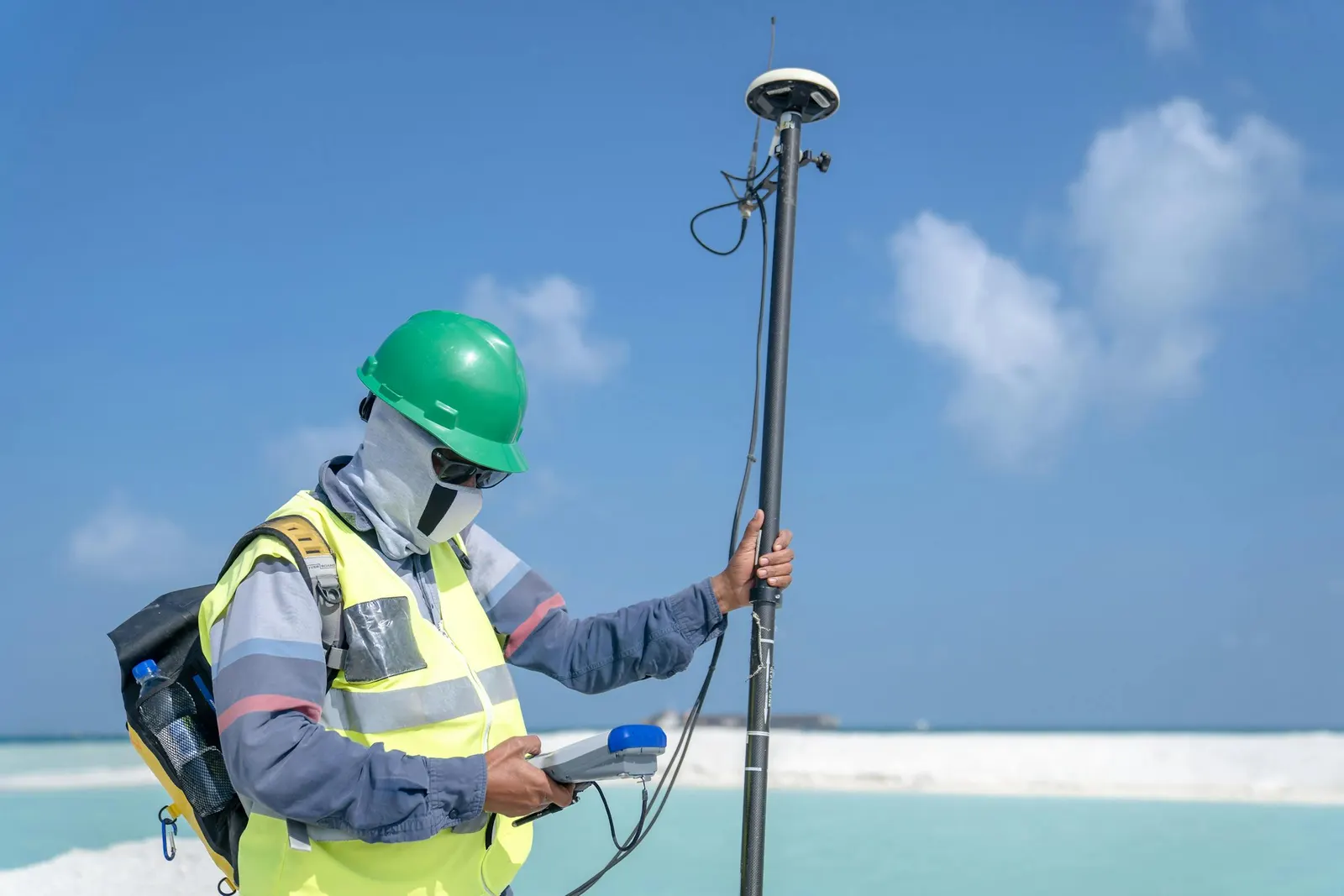
Total stations in our fleet
 From our field work
Total stations
Survey instruments for precise angle and distance measurement — control networks, layout, and as-builts.
such as Leica TS16, Viva TS, Topcon ES-series
Representative total-station instruments from the GeoGiza fleet of 90. Photographs are illustrative of the class.
What the fleet has measured
- 90
- instruments in the fleet
- robotic and manual total stations among them
- 3000+
- km of roads set out & surveyed
- the work robotic stake-out speeds up most
- 1,000+
- survey projects delivered
Explore further
References
- Total station, GNSS, and laser-scanner specifications (Leica) — Leica Geosystems
- Total station and GNSS specifications (Topcon) — Topcon Positioning
- ISO 17123 series — Field procedures for testing geodetic and surveying instruments — International Organization for Standardization (ISO)