

Four systems overhead, not one
A decade ago, setting a control point in a tight Cairo side-street meant watching the satellite count fall below the threshold and waiting for GPS to drift back into a usable window. On the same lots today our receivers sit on a fixed solution almost immediately — not because GPS got better, but because they are tracking four systems at once: the United States' GPS (now flying GPS III), Europe's Galileo, China's BeiDou and Russia's GLONASS. On an open-sky alignment we routinely see 30-plus usable satellites where the GPS-only era gave us 8 to 10.
This is what people mean by GNSS modernization, and it changes the rhythm of field work more than the headline accuracy number. In this note we lay out — from our own road, rail and cadastral projects — what extra satellites actually buy you, where the real wins are, and what they do not solve.
Where we run multi-constellation GNSS
- 90
- instruments in our fleet
- GNSS, total stations, scanners, drones, levels, sonar
- 3000+
- km of roads surveyed
- long open-sky alignments where geometry matters
- 1,000+
- survey projects delivered
- urban cadastral to desert corridors
What more satellites actually buy you
It is tempting to assume that doubling the satellite count doubles the accuracy. It does not. A well-conditioned RTK fix on a short baseline lands in roughly the same typical ±15–25 mm band whether you tracked 12 satellites or 32 — that figure is governed by your correction source, multipath and baseline length, not by raw satellite quantity. What the extra constellations give you is three concrete things we rely on every day:
- Geometry. More satellites spread across the sky lowers PDOP — the dilution-of-precision term that scales your error. A site that used to give a marginal PDOP under GPS-only is now comfortably strong.
- Redundancy. With four systems, losing six satellites behind a building no longer drops you below the minimum to compute a fix. You stay fixed where a single-constellation receiver would go float.
- Modernized signals. The newer L5 / E5 / B2a bands are cleaner against ionospheric and multipath error, which matters on reflective façades and over water.
The honest summary: multi-constellation GNSS mostly buys you reliability and speed, and only secondarily a tighter number — and that reliability is exactly what keeps a crew productive.
GPS-only vs full multi-constellation, in practice
| Criterion | GPS-only receiver | Multi-constellation (GPS+Galileo+BeiDou+GLONASS) |
|---|---|---|
| Usable satellites, open sky | ~8–10 | ~30+ |
| Behaviour in narrow streets / tree cover | Often drops to float | Usually holds a fix |
| Time to first fix | Slower, weather-dependent | Fast, consistent |
| Typical RTK precision, clean baseline | ±15–25 mm (illustrative) | ±15–25 mm (illustrative) |
| Multipath resilience (modernized bands) | Limited | Better with L5/E5/B2a |
Precision figures are typical/illustrative industry ranges, not a guaranteed spec — the real win of multi-constellation is reliability under obstruction, not a smaller number on a clean point.
Illustrative satellites visible by constellation (open sky)
How we set up a multi-constellation RTK session
- 1
Plan the window: check almanac/PDOP for the site and confirm no constellation outage is flagged for your epoch.
- 2
Enable every constellation the receiver licenses — GPS, Galileo, BeiDou and GLONASS — rather than leaving GPS-only defaults.
- 3
Turn on the modernized bands (L5 / E5 / B2a) for reflective urban or waterfront sites to cut multipath.
- 4
Set a realistic elevation mask (we typically work near 10–15°) and confirm corrections cover the constellation mix you enabled.
- 5
Initialize on a known control point, verify the fix on a second independent point, and only then start collecting.
- 6
Tie everything to the correct datum and EPSG projection before exporting — a multi-constellation fix is only as good as its reference frame.
The reference frame still rules
More satellites do not change the most common source of a wrong coordinate on a plan: the datum and projection. Every fix — single- or multi-constellation — must be defined against the correct reference frame and projection (look up the exact EPSG code for the job and confirm it matches the deliverable). We treat the EPSG definition as a deliverable in its own right, recorded in the field report alongside the observations.
The GNSS receivers we run these sessions on
 From our field work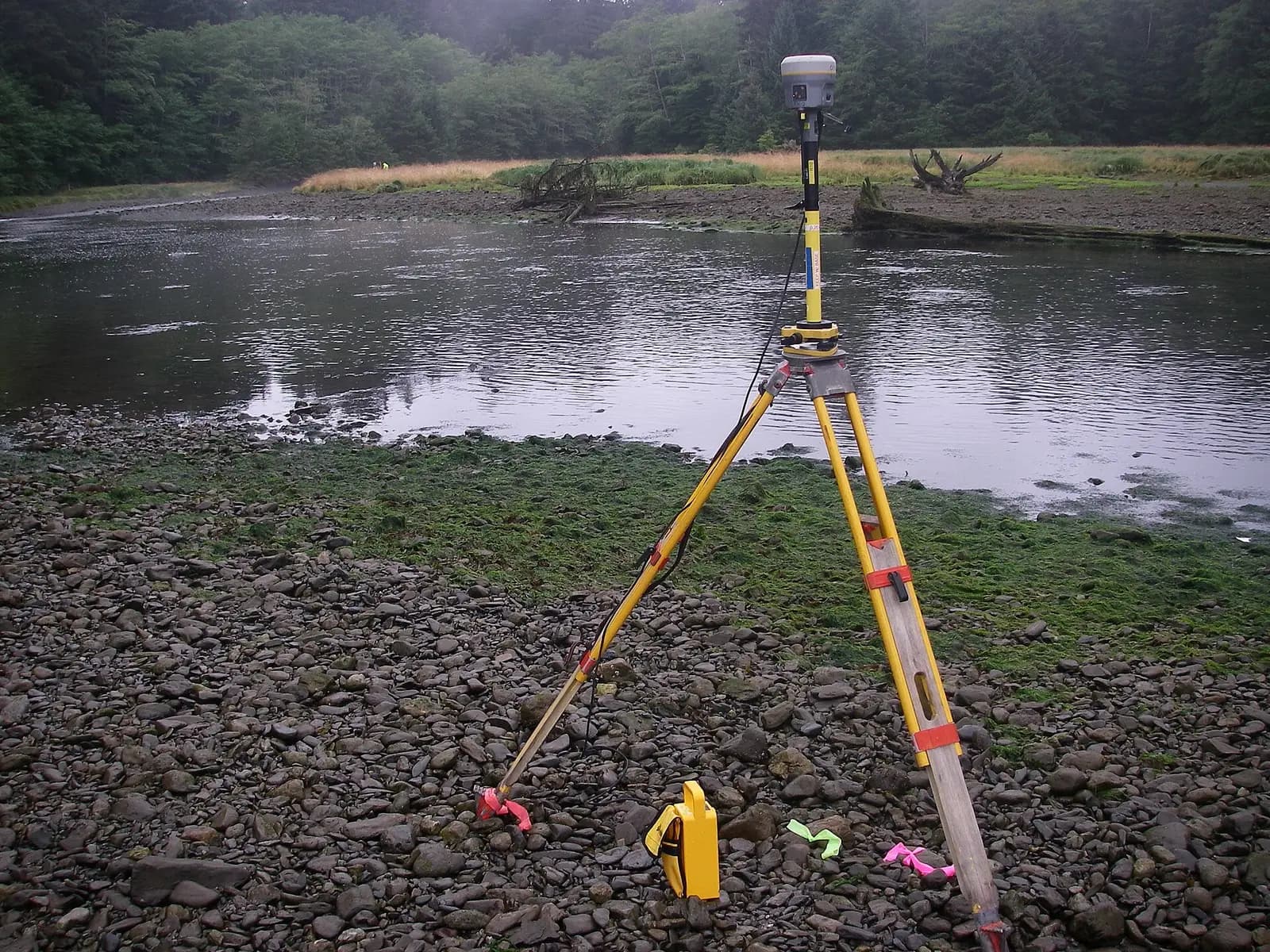
GPS / GNSS / RTK receivers
Survey-grade GPS receivers for centimeter-accurate satellite positioning (RTK) — control, topographic, and cadastral work.
such as Trimble R10/R8, Topcon Hiper V, Leica GS18
Multi-frequency, multi-constellation survey-grade GNSS from our fleet — illustrative of the class, configured per job.
Take it further
References
- Global Positioning System (GPS) program — modernization and signal performance — U.S. Government — GPS.gov
- Galileo — the European Global Navigation Satellite System — EU Agency for the Space Programme (EUSPA)
- EPSG registry of coordinate reference systems and map projections — EPSG Geodetic Parameter Dataset