

The map of the language, before the map of the land
Every project we deliver starts with a conversation, and in that conversation the same dozen words come up: topographic survey, point cloud, orthomosaic, LiDAR, GIS, GNSS, geoid, datum, projection, contour, photogrammetry, BIM. Clients use them confidently, contractors use them loosely, and the two rarely mean exactly the same thing. So before we put a single instrument over a point, we make sure everyone is speaking the same language.
This is that shared language. We have written it the way our crews actually talk on site — not as textbook definitions, but as a working map of how the terms connect. Because that is the part most glossaries miss: these words are not a flat list. They form a pipeline. Reality goes in one end as measured points, and a usable deliverable comes out the other. Understand the order, and the jargon stops being noise and starts telling you what stage of the work you are looking at.
The vocabulary, grounded in real work
- 1,000+
- survey projects delivered
- Every term below has been used in anger on real sites.
- 90
- instruments in our fleet
- Total stations, GNSS, scanners, drones, levels, sonar.
- 800,000+
- feddans levelled
- Where geoid, datum and levelling stop being abstract.
Capture: how reality becomes data
The first group of terms is about capturing the physical world. A topographic survey is the parent of them all — it is the measured description of a piece of ground: its shape, levels, and the features on it (kerbs, manholes, trees, buildings). Everything else in this section is a method for producing one, or a product that comes out of one.
A total station is the classic instrument — an electronic theodolite that measures angles and distances to a prism, point by point, with the tightest accuracy we carry. GNSS receivers (more on the name below) fix position from satellites, ideal for open ground and control. A laser scanner sweeps a site and records millions of points per second as a point cloud — the raw, survey-grade 3D measurement of everything in view. A drone flies a grid of overlapping photos, and photogrammetry software turns that overlap into both a point cloud and an orthomosaic: a single, geometrically corrected aerial image you can measure distances on directly, unlike an ordinary photo. LiDAR — light detection and ranging — is the same idea as a laser scanner but typically flown, pulsing laser to measure range and build a point cloud from the air, even seeing the ground through vegetation gaps.
The key relationship: point cloud, orthomosaic and LiDAR are how we capture; the topographic survey is what we deliver. A point cloud is not a finished model — it is the evidence. We build surfaces, contours (lines joining points of equal height) and quantities from it afterwards.
Four capture methods, when we reach for each
| Criterion | Total station | GNSS RTK | Laser scanner | Drone + photogrammetry |
|---|---|---|---|---|
| Best for | Tight detail, structures, control | Open ground, large areas, control | Dense 3D of complex surfaces | Large sites, fast coverage, imagery |
| Output | Discrete points | Discrete points | Point cloud | Point cloud + orthomosaic |
| Typical relative accuracy (illustrative) | ±2–5 mm | ±15–25 mm | Millimetre-class on surfaces | Centimetre-class with ground control |
| Needs sky view | No | Yes | No | Yes |
| Capture speed | Slow, point by point | Fast | Very fast | Fastest over area |
Accuracy figures are typical/illustrative ranges, not guaranteed specs — real performance depends on configuration, geometry and field test per ISO 17123. We routinely combine methods on one project.
Reference: the words that make surveys line up
This is the group that quietly decides whether your project succeeds, and the one clients most often skip. Coordinates only mean something relative to a reference frame, and four terms define it.
The Earth is not a sphere, so we model it. An ellipsoid is a smooth mathematical squashed sphere we use for horizontal calculation. The geoid is the real, lumpy shape that mean sea level would follow if it ran under the continents — it is what heights are honestly measured against, and it is why a GNSS 'ellipsoidal height' is not the same as the level you read on site. A datum ties that model to actual ground: it is the agreed starting reference (which ellipsoid, anchored where, in which orientation) that every coordinate is counted from. A projection is the recipe for flattening that curved reference onto a flat map or drawing — there is no way to do it without some distortion, so the projection choice is a deliberate trade-off.
Get the datum wrong and millimetre-accurate field work still lands metres off. The numbers look perfectly valid — they just refer to a different frame.
That is not a hypothetical. It is the single most common cause of two correct datasets refusing to overlay. On every job we confirm datum, geoid model, units and projection in writing before observation, so the deliverable drops straight into the client's existing data.
The reference vocabulary in one table
| Term | Plain-language meaning | What it controls |
|---|---|---|
| Ellipsoid | A smooth mathematical 'almost-sphere' for the Earth | Horizontal coordinate maths |
| Geoid | The real, lumpy mean-sea-level surface under everything | Honest, level-based heights |
| Datum | The agreed reference everything is counted from | Whether two surveys line up at all |
| Projection | The recipe to flatten the curved Earth onto a drawing | Map distortion and grid coordinates |
| GNSS | All satellite positioning systems together | How position is fixed in the field |
| Cadastre | The official record of land parcels and ownership | Legal boundaries, not just shape |
These six terms decide whether your data is interoperable. We pin them down before fieldwork, never after. · Definitions follow standard surveying-profession usage; see FIG for the international reference.
Why method choice is really an accuracy choice
Why we test, not assume
A specification sheet states what an instrument can do under ideal conditions; it does not tell you what your instrument did this morning, on this site, in this heat. That is exactly what ISO 17123 exists for — a standardised field-test procedure for checking and proving the real accuracy of total stations, levels and GNSS gear. We run these checks so that when we quote an accuracy, it is measured on our equipment, not copied off a brochure.
Use: how data becomes a decision
The last group is about using the captured, referenced data. GIS — a Geographic Information System — is the software environment that holds spatial data as layers (roads, parcels, utilities, levels) and lets you query, analyse and map it; it is where a survey stops being a drawing and becomes something you can ask questions of. BIM — Building Information Modelling — is the same intelligence applied to a structure: a 3D model where every element carries data, and which we increasingly feed directly from a scanned point cloud (scan-to-BIM). Quantity take-off is the act of measuring volumes and areas — cut, fill, concrete, asphalt — straight from the survey model, which on our road projects is how a topographic survey turns into a bill of quantities. And the cadastre sits slightly apart: it is the legal record of who owns which parcel of land, the boundary layer where surveying meets law.
Read top to bottom, the whole vocabulary is one pipeline: GNSS, total stations, scanners and drones capture; datum, geoid and projection reference; GIS, BIM, contours and take-off use. Once you can place a term in that flow, you always know what you are looking at — and what question to ask next.
How a topographic survey moves through the whole vocabulary
- 1
Agree the reference frame: confirm datum, geoid model, units and map projection with the client in writing before anyone goes to site.
- 2
Establish control: observe a GNSS and total-station control network so every later measurement hangs off known, checked points.
- 3
Capture reality: collect detail with the right method — total station for tight features, GNSS for open ground, laser scanner or drone where a point cloud or orthomosaic is needed.
- 4
Process the data: register the point cloud, build the orthomosaic, derive the surface, and verify accuracy against control by standardised field test.
- 5
Deliver in usable form: generate contours, quantities and the topographic plan, and hand over GIS-ready or BIM-ready data that drops straight into the client's environment.
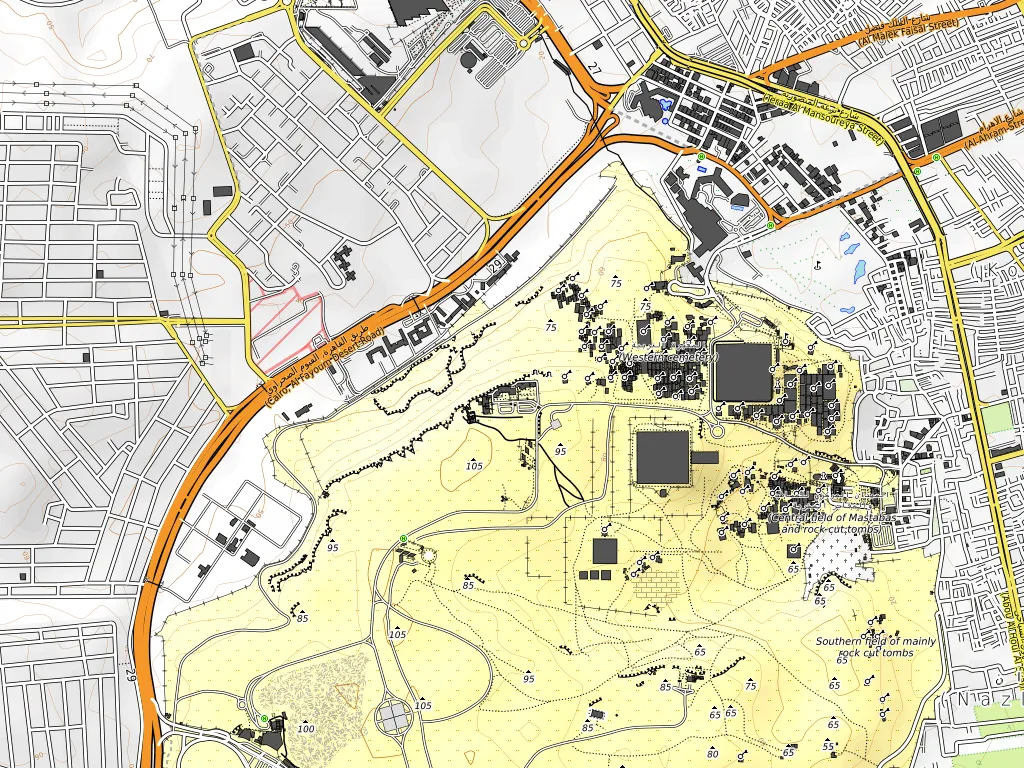
Where the words meet the ground
Go deeper
References
- International Federation of Surveyors publications on professional and cadastral standards — International Federation of Surveyors (FIG)
- ISO 17123 series — Field procedures for testing geodetic and surveying instruments — International Organization for Standardization (ISO)