

'Fixed' is the start of the question, not the answer
The most dangerous habit in RTK surveying is trusting the colour of a light. The receiver flashes fixed, the controller shows a tight precision estimate, and it is tempting to log the point and move on. But on our road and infrastructure projects the points that came back wrong almost never looked wrong in the field — they had a fixed solution and a confident-looking precision. The error came from somewhere the receiver could not fully see.
Understanding RTK error is mostly about understanding four things and how they stack: multipath, satellite geometry (PDOP), baseline length, and the atmosphere. None of them is exotic. All of them are manageable with a handful of field habits that cost seconds, not money.
The four error sources that decide an RTK point
- Multipath
- Reflected signal near walls, fences, vehicles, water
- Can survive a fixed solution
- PDOP
- Satellite geometry — spread across the sky
- Lower is better
- Baseline
- Distance from base / correction source
- Error grows with distance
- Atmosphere
- Ionospheric & tropospheric delay
- Worst on long baselines
Multipath: the error that hides inside a good-looking fix
Multipath is the signal arriving twice — once direct from the satellite, once bounced off a nearby surface. The receiver blends them and the position drifts. It is the one error source that routinely survives a fixed solution, which is exactly why it is the one that bites. On site you create multipath every time you set up beside a block wall, a chain-link fence, a steel container, a parked vehicle, or standing water — and reflective surfaces are everywhere on a construction site.
Our habits are simple. Keep the antenna clear of vertical reflectors and away from water where we can. Where we cannot, we lean on a multipath-resilient antenna and, above all, we re-occupy: take the point, let it re-initialise, take it again. Two independent fixes that agree have almost certainly beaten multipath; two that disagree just saved you a site revisit.
Geometry and baseline: watch PDOP, keep the baseline honest
Satellite count is the number everyone glances at, but geometry is what matters. If the visible satellites are clustered in one part of the sky, your position is weak even with a dozen in view — that is what a high PDOP is telling you. Modern multi-constellation receivers (GPS, GLONASS, Galileo, BeiDou) make good geometry the norm, but urban canyons, deep cuts and tree lines still knock satellites out and push PDOP up. We watch the PDOP value, not just the count.
Baseline length is the quieter killer. Single-base RTK error grows with distance from the base because the atmosphere over the rover stops matching the atmosphere over the base. On precise work we keep baselines short or use a network/VRS correction so the effective baseline stays small — and when accuracy has to hold over real distance, we stop using RTK and observe static.
How the error sources stack into a position
Error source, where you meet it, and the field habit that shrinks it
| Error source | Where it bites on site | Field habit that shrinks it |
|---|---|---|
| Multipath | Beside walls, fences, vehicles, containers, water | Clear the antenna; re-occupy; multipath-resilient antenna |
| Satellite geometry (PDOP) | Urban canyons, deep cuts, tree lines | Watch PDOP not count; wait for a better window; use multi-constellation |
| Baseline length | Far from base / single-base RTK over distance | Keep baselines short; use network/VRS; switch to static for distance |
| Atmosphere (iono/tropo) | Long baselines, active ionosphere, dawn/dusk | Network correction; shorter baselines; re-observe at a different time |
| Initialisation / blunder | Anywhere — quietly | Re-occupy; daily check on a known control point |
The whole table is one idea: every RTK error has a cheap field habit that catches it. · Habits reflect standard RTK practice; see NGS RTK guidance and gps.gov.
Our field routine for RTK you can trust
- 1
Start the day on a known control point and confirm the RTK fix reproduces its published coordinate within tolerance — this validates the base, the correction stream and the datum before any new work.
- 2
At each setup, check the satellite geometry (PDOP) and sky view; if PDOP is high or satellites are blocked, wait for a better window rather than logging a weak point.
- 3
Position the antenna clear of walls, fences, vehicles and standing water to suppress multipath; if the location is unavoidably reflective, flag the point for extra checking.
- 4
Let the solution reach a stable fixed state and confirm the precision estimate has settled before recording the point.
- 5
Re-occupy critical and suspect points independently — let the solution re-initialise, ideally at a different time, and accept only when the two fixes agree within tolerance.
- 6
Close the day back on the known control point; a clean re-check confirms nothing drifted across the session.
Per NGS RTK guidance: verify, don't assume
Published RTK guidance is consistent on one point — a fixed solution must be verified, not assumed. Independent re-observation (a second occupation, ideally at a different time so the satellite geometry has changed) and a daily check against a known control point are the accepted ways to confirm an RTK position is real. We treat both as non-negotiable on deliverable work.
Antenna placement is half the battle

The GNSS receivers we run this routine on
 From our field work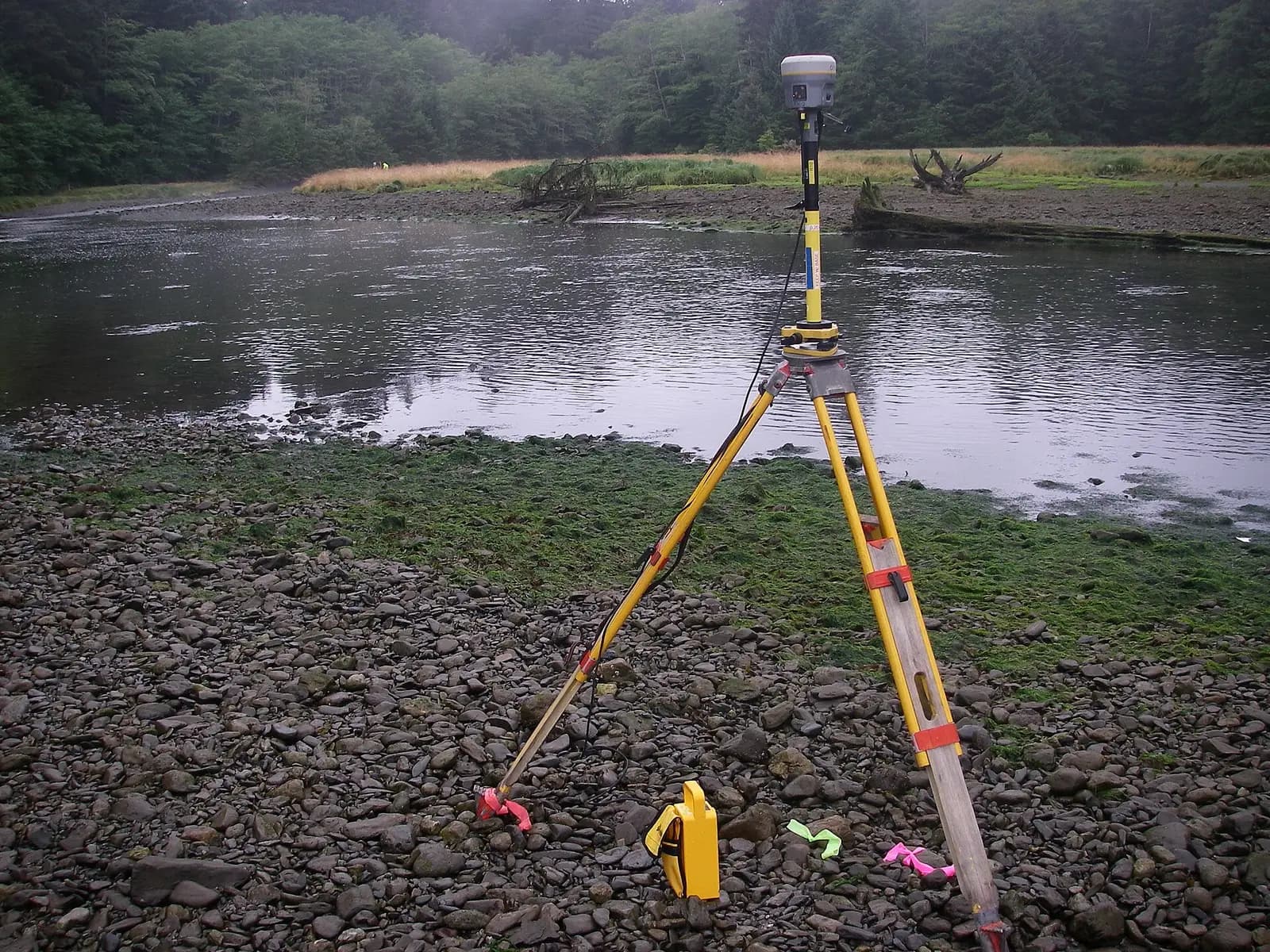
GPS / GNSS / RTK receivers
Survey-grade GPS receivers for centimeter-accurate satellite positioning (RTK) — control, topographic, and cadastral work.
such as Trimble R10/R8, Topcon Hiper V, Leica GS18
Representative GNSS-RTK receivers from the GeoGiza fleet. Photographs are illustrative of the instrument class.
Take it further
References
- Guidelines for Real-Time Kinematic (RTK) GNSS surveying and geodetic control — US National Geodetic Survey (NGS/NOAA)
- Global Positioning System (GPS) program — modernization and signal performance — U.S. Government — GPS.gov
- GNSS/RTK receiver and survey solution specifications (Trimble) — Trimble