

What “±2 cm” really means
Every other tender we read puts a single number in the accuracy box — usually ±2 cm — as if that settles it. It doesn’t. On our road and rail projects a number like that is the start of a conversation, not the end of one. Two centimetres at what confidence level? On which datum, at which epoch? Measured how, and checked against what? Strip those questions away and “±2 cm” is just marketing.
This is the hub article for our accuracy-standards series. The job here is to make the vocabulary precise: how accuracy is defined, how it is proven in the field, and how the three reference bodies a working surveyor actually leans on — ISO for instrument tests, ASPRS for positional classes, and FIG for practice — fit together. We’ll keep it concrete and pull the illustrative numbers from where they belong: published standards and field experience, never the spec sheet.
The fleet and the record behind these numbers
- 90
- instruments in our fleet
- total stations, GNSS, scanners, drones, levels
- 1,000+
- survey projects delivered
- each judged on check-point residuals
- 800,000+
- feddans levelled
- vertical control at production scale
- 3000+
- km of roads surveyed
- where a wrong datum costs real money
- 600+
- km of railways
- tight tolerance, repeated checks
- 2,500+
- clients
- who get a stated standard, not a slogan
Accuracy is not precision — and both have a number
Precision is repeatability: shoot the same point ten times and see how tightly the results cluster. Accuracy is how close that cluster sits to the true value on the correct reference frame. The classic trap is a tight RTK cluster — beautifully precise — that is shifted by decimetres because it’s on the wrong datum or epoch. Precise, and wrong.
The other word that gets thrown around loosely is tolerance. Tolerance is what the deliverable must achieve; accuracy is what the instrument and method can achieve. A digital level reading to fractions of a millimetre per kilometre is overkill for a contour map at half-metre intervals and barely adequate for some deformation monitoring. Matching method to tolerance — not chasing the smallest catalogue figure — is the actual skill.
Confidence levels: the silent multiplier
A standard deviation (1σ) covers roughly 68% of cases; the 95% figure most clients assume is closer to 2σ. So a “±2 cm” quoted at 1σ and a “±2 cm” quoted at 95% describe instruments roughly a factor of two apart in real quality. When we write an accuracy statement, we always say which one we mean. If a supplier won’t, that tells you something.
Typical accuracy by method (illustrative)
| Method | Typical accuracy | What it’s judged against | Where we use it |
|---|---|---|---|
| Total station (angle + EDM) | ±2–5 mm | ISO 17123 field test → standard deviation | Control, setting-out, as-builts |
| GNSS static (long occupation) | ±3–8 mm | Network adjustment residuals | Primary control, geodetic ties |
| RTK / network RTK | ±15–25 mm horizontal | Check shots on known control (NGS RTK) | Topo detail, stake-out, drone GCPs |
| Digital level | ±0.3–1 mm per km double-run | Loop misclosure | Vertical control, 800k+ feddans levelled |
Indicative ranges for planning — not contractual figures. Each job is verified on its own check points. · Ranges are typical/illustrative, consistent with manufacturer field-test procedures (ISO 17123) and RTK guidance (NGS); confirm per instrument and per project.
Total station vs GNSS — choosing the tool for the tolerance
| Criterion | Total station | GNSS (RTK/static) |
|---|---|---|
| Relative accuracy (short range) | ±2–5 mm, typical | ±15–25 mm RTK, typical |
| Needs sky view / satellites | No — works under cover | Yes — fails in canyons & dense canopy |
| Speed over open ground | Slower, line-of-sight | Fast, no inter-visibility |
| Absolute position on a datum | Needs control to start | Direct, given a good reference frame |
| Best role on our projects | Precise control & setting-out | Coverage, GCPs, long baselines |
Illustrative trade-offs. On most jobs we run both: GNSS to establish and tie control, the total station to densify it to millimetre tolerance.
Typical 95% horizontal accuracy by method (illustrative)
Per ISO 17123 and ASPRS
ISO 17123 is the field-test procedure that turns a brochure claim into a defensible standard deviation for <em>your</em> instrument on <em>that</em> day. ASPRS positional-accuracy practice then reports the survey result as RMSE and a 95% confidence value, computed against independent check points and stated separately for horizontal and vertical. FIG good practice ties it together with documented control and a clear datum statement; NGS RTK guidance governs the satellite-positioning workflow. The throughline: an accuracy claim is only as good as the check points that prove it.
How we prove an accuracy claim in the field
- 1
Fix the reference frame first: state the datum, projection and epoch, and tie into known geodetic control before any detail is shot.
- 2
Field-test the instrument per ISO 17123 (angle, distance and — for levels — a double-run) to derive a real standard deviation, not the catalogue figure.
- 3
Establish and adjust a control network, then check residuals; a clean adjustment is the foundation every later coordinate inherits.
- 4
Collect detail with the right tool for the tolerance — GNSS for coverage, total station to densify to millimetre control.
- 5
Survey independent check points not used in the adjustment, and compute residuals separately for horizontal and vertical.
- 6
Report results as RMSE and 95% confidence (ASPRS-style), state the datum and method, and hand over the check-point evidence with the deliverable.
Accuracy is set in the field, not on the spec sheet
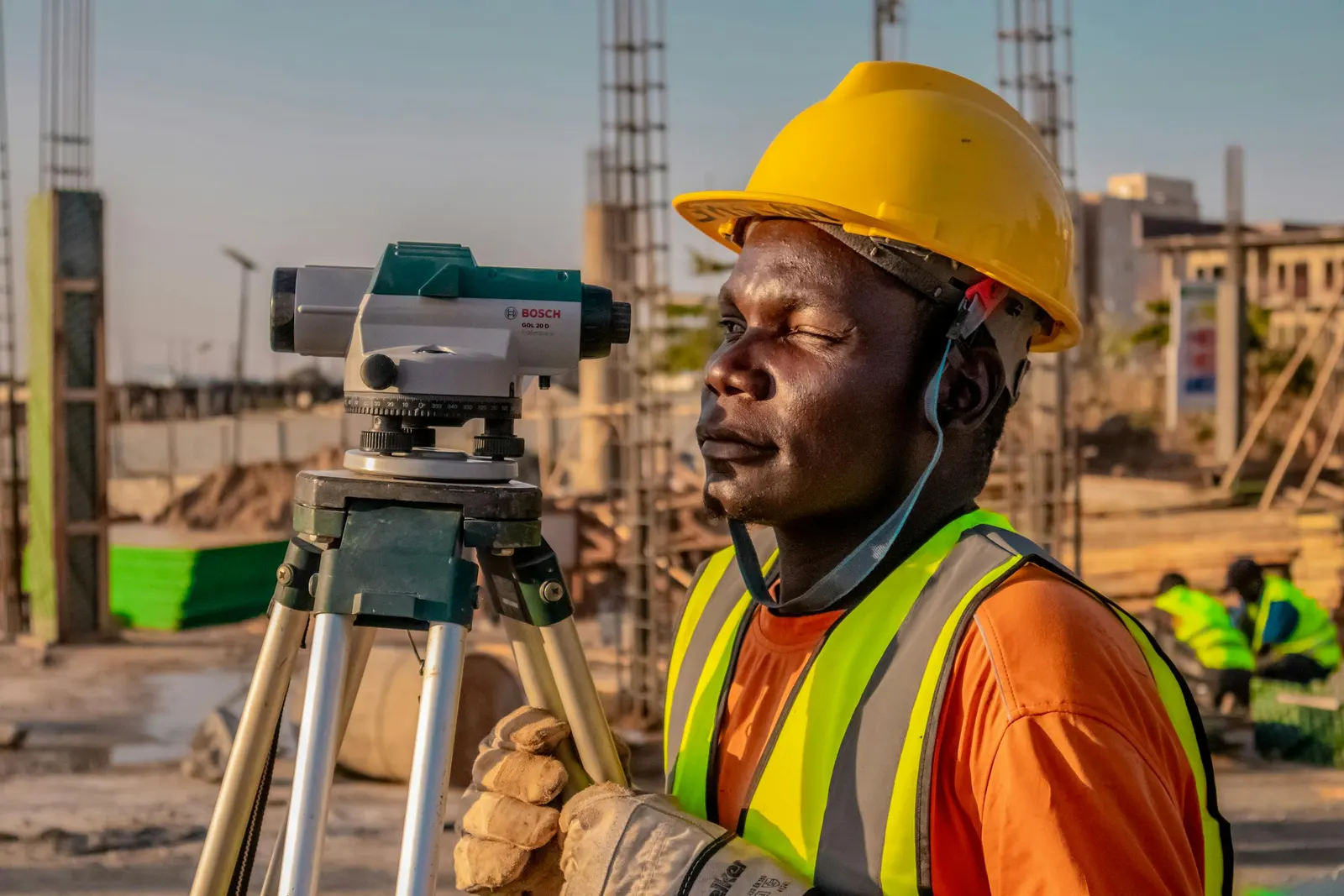
The instruments behind the standard
 From our field work
Total stations
Survey instruments for precise angle and distance measurement — control networks, layout, and as-builts.
such as Leica TS16, Viva TS, Topcon ES-series
 From our field work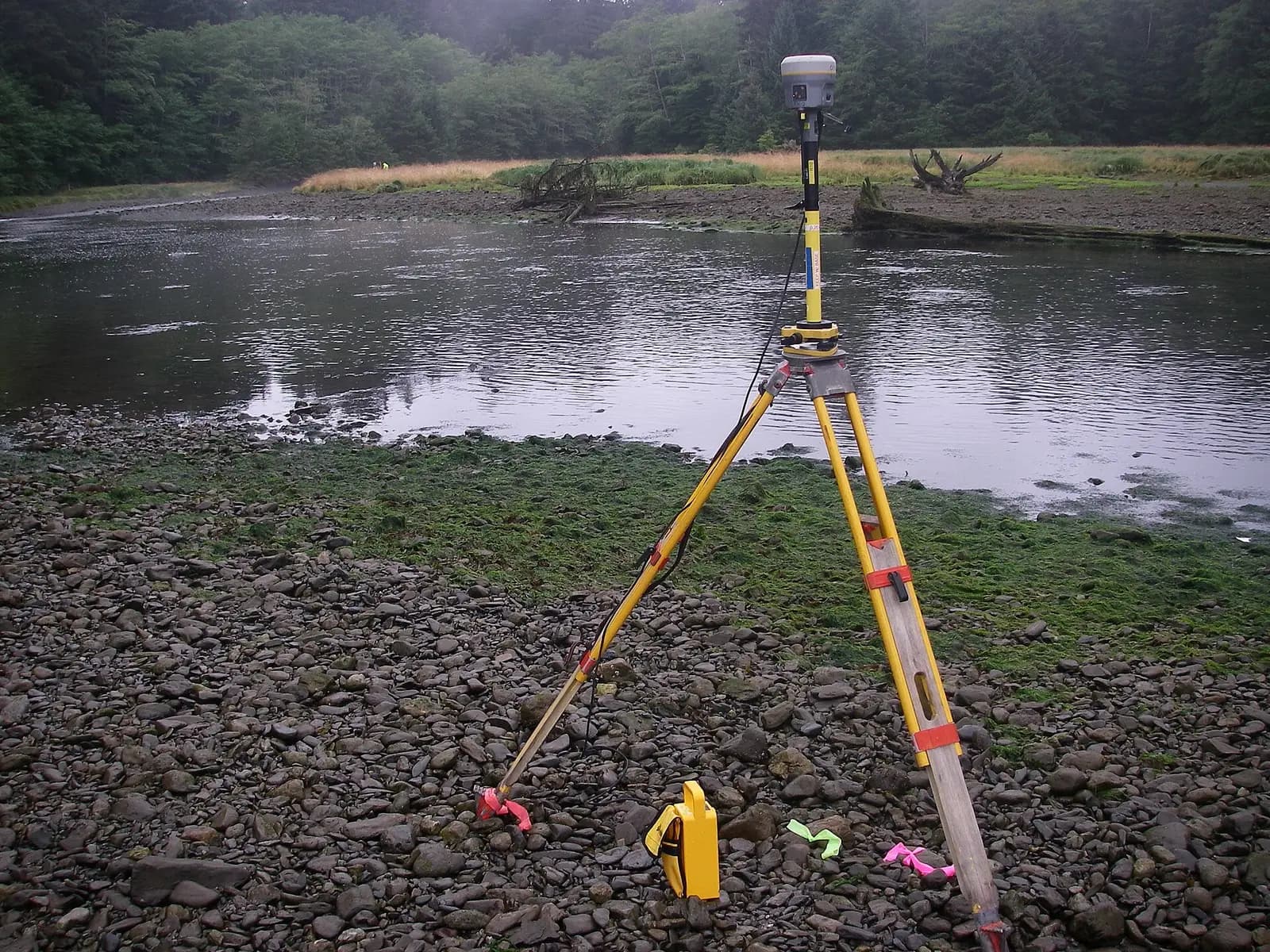
GPS / GNSS / RTK receivers
Survey-grade GPS receivers for centimeter-accurate satellite positioning (RTK) — control, topographic, and cadastral work.
such as Trimble R10/R8, Topcon Hiper V, Leica GS18
Total stations for millimetre control and setting-out; GNSS for coverage, control ties and ground-control points. Both are field-tested before they earn a place on a deliverable.
Keep reading
References
- ISO 17123 series — Field procedures for testing geodetic and surveying instruments — International Organization for Standardization (ISO)
- Positional Accuracy Standards for Digital Geospatial Data (2nd ed.) — American Society for Photogrammetry & Remote Sensing (ASPRS)
- International Federation of Surveyors publications on professional and cadastral standards — International Federation of Surveyors (FIG)
- Guidelines for Real-Time Kinematic (RTK) GNSS surveying and geodetic control — US National Geodetic Survey (NGS/NOAA)